
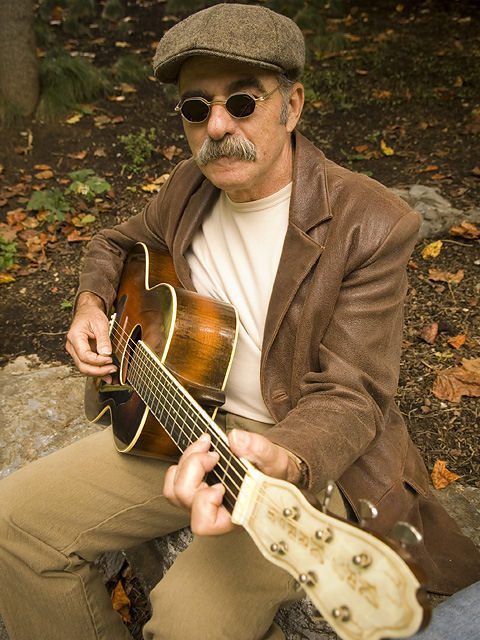
ROY BOOK BINDER
Finger-Pickin’ Good: Roy Book Binder
Live at McCabe’s June 25, 2010
Dedicated to Larry Abbott, Vietnam Veteran for Peace; thank you for the tickets!
What would you give for Rev. Gary Davis’s phone number? Roy Book Binder stumbled on it by accident when he returned to New York City in 1966 from his volunteer stint in the Navy, and heard an old black blues singer at a small club in Greenwich Village. He fell in love with the blues that night. After the show he asked the singer if he would teach him to play guitar, and was met with something less than enthusiasm. "You can steal it from me," he was told, "but I won’t give it to you." Finally, though, his persistence paid off, and two nights later the singer gave him a phone number. Is that really your phone number? Book Binder asked him. "Oh no-I can’t teach you-that’s Reverend Gary Davis’s phone number-he’ll teach you for five dollars a lesson.
A couple of nights later Roy Book Binder called the greatest blues guitarist in New York City and asked him to become his teacher. "When do you want to start?" the Reverend asked him. "How about a week from this Thursday," said the budding student. "I’m an old man," Gary Davis, said, "if you want lessons you better come over now."
So this pale face returning veteran, not knowing where it would lead, made his way to the blind preacher’s apartment in Harlem, a meeting which would change his life.
Born in Durham, North Carolina, Rev. Gary Davis made his first recordings in 1935 in New York City, along with Blind Boy Fuller. By the time Roy Book Binder met him he had already influenced the likes of Dave Van Ronk, Bob Dylan and Eric Von Schmidt, the "white blues singers" who had started out in Greenwich Village in 1962.
Indeed, on Dylan’s first album he credits the blues song he plays in open G with his then girlfriend Suzie Rotolo’s lipstick holder instead of a bottleneck-Baby Let Me Follow You Down-to Ric Von Schmidt, with his memorable spoken introduction: "Uh, I first heard this from ah Ric Von Schmidt…Ric’s a blues guitar player…I met him one day in the green pastures of uh…Harvard University."
But where did uh Ric Von Schmidt learn it? From the man who wrote it-uh that would be Reverend Gary Davis. It took a few years for the Reverend to get his name back on the song he composed, and you can thank Manny Greenhill, who started Folklore Productions, for that little piece of historical restoration. They are now based in Santa Monica under the watchful eye of his son Mitch Greenhill. All of Reverend Gary Davis’s copyrights and royalties have been administered through Folklore Productions for many years now, and you can be sure that his songs have not fallen into the public domain.
So when Roy Book Binder started as Rev. Gary Davis’s guitar student, Davis was already quite familiar with the way the Greenwich Village folk scene worked-they came up to Harlem to steal his stuff, and went down to Gerdes Folk City to be discovered.
Not anymore they didn’t: the first words out of his mouth in 1966, when Roy Book Binder proudly played him his version of Candyman were, "You play it just the way Dave Van Ronk plays it; I should know, because he got it from me."
And that’s how one of the great friendships and mentoring relationships in modern folk music was born-through brutal honesty and Roy Book Binder’s quick realization that it wasn’t the end of their relationship-it was the beginning. Properly chastened, he signed up to study at the hands of the master-and unlike many before him, never tried to pass off as his own something he learned from the Reverend Gary Davis.
It was something to behold, Roy Book Binder’s seamless melding of old and new, of Delta blues styles transmogrified through this urban legend, a blind, black street preacher who used his amazing finger-style guitar-playing and song-sermons to preach the gospel.
In addition to being a consummate performer and entertainer, Book Binder is a walking, talking living history of the blues and ragtime, performing both the traditional songs he picked up from the black singers he brings to (nearly) all-white audiences (there was one black woman in the entire audience, sitting right in front of me throughout, and utterly enchanted by Roy’s evocation of her musical heritage), and his own songs in that style.
One of those original songs is a tribute to Gary Davis, The Preacher Picked the Guitar, with lovely rhymes like "fret board" with "every chord" and finally, "to praise the Lord."
I learned a lot I didn’t know about Davis: he made only one record of actual blues songs in his career; it was then he got religion and disowned his secular (and salty) repertoire such as the aforementioned Baby Let Me Follow You Down and Candyman.
From now on he would use his extraordinary musicianship and guitar and singing ability on behalf of a higher calling-in much the same way that Little Richard came to abandon rock and roll for gospel music. The irony is that he sang spirituals like the blues-with the same passion and energy.
Roy Book Binder has captured that energy in a bottle, and brings it on tour throughout the country, but as he said many times during his show, he was happiest at McCabe’s. "It’s a real blessing being here, you know; it’s hard "out there," on the road. He also thanked their sound engineer Wayne Griffith profusely, for getting it just right-which he needed, since nothing plugged in, and he didn’t even use a thumb pick or finger picks-completely au natural. Book Binder plays an 80-year old S.S. Stewart Professional Model acoustic guitar, which took some explaining, as S.S. Stewart is known for its (now antique) open back five-string banjos with extraordinary fingerboard inlays.
Book Binder found this guitar was made in 1930, and only made once; it was subcontracted out to Gibson for manufacture, an L-2 model marketed under S.S. Stewart’s brand name-lavishly inlaid into the headstock. "This guitar changed my life," he said; no surprise his guitar had a story attached to it-so did all of his songs, which he now records under his own label-Peg Leg Records ("We walk in our own way").
He dedicated one of those songs, New Age Woman Blues (an original) to his first wife-"May she rest in peace…in Biloxi, Mississippi…with her new husband." Book Binder added that he’s always preferred younger wives, and older guitars. But he quickly exited that one-liner by noting that he was keeping his current wife-who was out there in the lobby selling his books and records for him.
He praised Peter, Paul and Mary for also standing up for Reverend Gary Davis’s publishing rights when they recorded his song Samson and Delilah. Their record label Warner Brothers Records wasn’t happy about having to share their publishing rights with a Harlem street singer who made his living-as Book Binder described in The Preacher Picked the Guitar-singing "for Jesus and spare change." They were even skeptical that he had written the song, and finally invited him in for an actual business meeting-not the usual practice of major labels.
Davis didn’t bring any lawyers with him-just his own charismatic presence and inability to tell or countenance a lie. Their staff of lawyers surrounding him, they asked, "Now, Reverend Davis, did you really write this song Samson and Delilah?" To the lawyers’ profound but premature relief, Davis replied, "No sir, I didn’t ‘write’ it…"
High fives all around-the company was off the hook, as Warner Brothers’ prepared to take his name off the title…then the preacher finished his sentence: "It was revealed to me in 1928, in Durham, North Carolina." To Peter, Paul and Mary’s credit, Rev. Gary Davis’s name is still on the song-and their recording of it helped him pay some outstanding bills.
Book Binder brings a bucketful of songs from other trailblazers as well, including Mississippi John Hurt, whose story he told of being rediscovered in the 1960s by northern white blues aficionados from a song Hurt wrote and recorded in the 1920s called Avalon, My Home Town, which led them to Avalon, Mississippi, where John still lived. They brought him up to the Newport Folk Festival in 1964, and he brought down the house.
When it came time to get paid, though, Hurt refused to accept their check from the Chase Manhattan Bank. Alan Lomax was advised of the problem they were having with Mississippi John, and came over to resolve the dispute. He assured him that Chase Manhattan was the biggest bank in New York, and his check wouldn’t bounce. Hurt still refused to accept it. Finally Pat Sky (a white folk blues performer whose relationship with John Hurt was akin to Book Binder’s with Rev. Gary Davis) stepped in and asked him, "What do you want us to do, John?" "I’ll take your check, Pat," replied John. "But John, Chase Manhattan is a huge bank, with holdings all over the world; if you won’t take their check, why would you take mine?" "I know where you live," replied the wise old blues master.
Finally, Roy Book Binder finished his second set (a rarity at McCabe’s these days-to have a full concert with an intermission) by paying tribute to yet another great blues and ragtime guitarist, Pink Anderson, from Spartanburg, South Carolina. If Book Binder can be said to have a "hit song," it would be Pink Anderson’s version (recorded on Prestige Records) of Travelin’ Man, which is the title of Roy’s first album from 1971. Roy plays it with just the right tone of deadpan humor, an epic picaresque tale about a man named Boon who survives every in extremis situation he is thrown into, only to escape like Houdini, until in the last amazing scene, he escapes from his own coffin:
He was a travelin’ man
must have been a travelin’ man,
he was the most travelinest man
that ever was in the land
He traveled everywhere,
he was known for miles around
But he didn’t get caught and he didn’t get whupped
‘Til the police shot him down.
But like the Travelin’ Man himself, Book Binder wasn’t through. He came back for a magnificent double encore, to tell us one last story about meeting "the only blues guitarist that Robert Johnson ever chased after, ‘Hacksaw’ Arnie." (What would a blues show be without a good story about Robert Johnson-and the only guitarist that might have been better!) The story set up his closing song, for it was Hacksaw Arnie that led him to Delta blues man Willie Brown, from whom he learned his classic finger-style guitar arrangement of Mississippi Blues. Take it from a word man, there are no words to describe it. But thanks to Roy, these old blues men are in good hands.
So to answer my first question, how much would you give for Reverend Gary Davis’s phone number? Roy Book Binder gave his life. Keep on pickin’, Roy; that was a show!
Ross Altman has a Ph.D. in English. Before becoming a full-time folk singer he taught college English and Speech. He now sings around California for libraries, unions, schools, political groups and folk festivals. You can reach Ross at Greygoosemusic@aol.com